
History & Remembrance
From the Middle Ages to the present day — the history of Combles is about far more than 1914-1918. Some accounts are based on oral tradition and are marked as such.
Timeline
Key dates in the village's history
- AntiquityUnverified
Traces of Gallo-Roman settlement
Local sources mention traces of two Gallo-Roman settlements within the boundaries of Combles. This has yet to be confirmed by official archaeological records and should not be taken as established fact.
- 1046
Frégicourt recorded as a separate village
Frégicourt, once a separate commune and parish right next to Combles, is recorded as early as 1046 — one of the oldest settlements in the area.
- c. 1090
“Camuli”, an early form of the name Combles
An early form of the name Combles, “Camuli”, appears in place-name sources. Other variants followed: “Combla” (1106), “Cumbi” (1129), then “Cumbles”/“Combles” in the 12th century.
- 1181
Combles passes to the Abbey of Mont-Saint-Quentin
The Benedictine Abbey of Mont-Saint-Quentin (Péronne) and the chapter of Saint-Fursy dispute the ownership of Combles. The village finally goes to the abbey.
- 1793
Around 1,400 inhabitants
After the French Revolution, Combles becomes the seat of a canton — a role it keeps for more than two centuries, until the cantonal reform of 2015.
- 1834
Frégicourt joins Combles
Frégicourt is officially merged into Combles for administrative purposes.
- 1889
The railway arrives
The Albert–Péronne–Ham branch line opens, with a station serving Combles. The railway changes the way people travel and goods are traded.
- 1911
Over 1,100 inhabitants on the eve of the war
The 1911 census still records just over 1,150 inhabitants in Combles, on the eve of the First World War.
- 26 September 1916
The capture of Combles
French and British forces converge on Combles and the village falls to the Allies during the Battle of the Somme. It is almost entirely destroyed: houses collapsed, the church in ruins, the cemetery damaged.
- 1920
Croix de Guerre 1914–1918
On 27 October 1920 the commune of Combles is awarded the Croix de Guerre 1914–1918 in recognition of the hardships it suffered during the war.
- 1920s
Rebuilding the village
Combles is rebuilt: housing, public buildings, roads and Saint-Vaast Church. The war memorial was probably erected between 1920 and 1923.
- 1940–1945Unverified
Combles in the Second World War
German occupation. Georges Ovide Laurent Guillemont, mayor of Combles since 1929, is said to have been dismissed in November 1940 and then deported to Germany for helping members of the Resistance; he died in Wieda on 3 April 1945. This account still needs to be checked against the prefecture archives.
- 2004
Return of the 1784 parish register
A Combles parish register from 1784 — rescued from the ruins of the town hall during the First World War by a lieutenant of the 110th Infantry Regiment and later found in Belgium — is returned to the Somme departmental archives.
- 2011
Frégicourt memorial
A memorial is unveiled on the site of the former village of Frégicourt, destroyed during the Great War and never rebuilt.
- Today
Combles today
Combles today has around 750 inhabitants and belongs to the Haute Somme community of communes.
History articles
Stories, places and people that shaped Combles
Combles today
A commune of the Haute Somme community of communes
The population of Combles never returned to its 19th-century level. Today the commune has around 750 inhabitants.
Did you know? The parish register saved from the ruins
An 18th-century document, the destruction of 1916 and the safeguarding of memory today
A Combles parish register from 1784 is said to have been recovered from the ruins of the town hall during the war, before being returned to the Somme archives in 2004.
Combles in the Second World War
German occupation and the fate of mayor Georges Ovide Laurent Guillemont
The history of Combles does not end with the reconstruction: the village was once again under German occupation from 1940 to 1945.
Reconstruction and remembrance
A village almost entirely to rebuild
After the Armistice, Combles was among the hardest-hit villages of the Upper Somme. The reconstruction of the 1920s reshaped the village, including Saint-Vaast Church and the war memorial.
Combles 1914–1918
The village at the heart of the Battle of the Somme
In 1916, Combles was part of a major German defensive system before falling to the Allies on 26 September 1916, almost entirely destroyed.
The old station and the railway
The Albert–Péronne–Ham branch line
Combles was served by the railway from 1889, when the Albert–Péronne–Ham branch line opened.
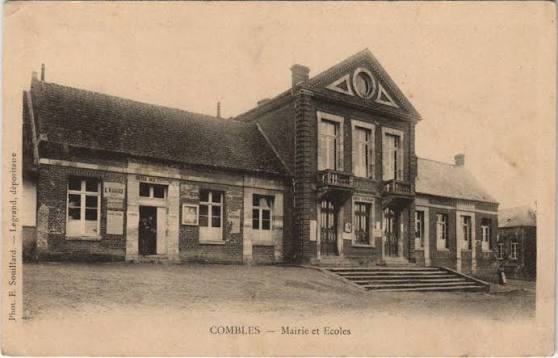
Combles in the 19th century
A busier town than today
After the French Revolution, Combles became the seat of a canton and, in the 19th century, had a much larger population than today.
Frégicourt, the lost village
A former commune destroyed and never rebuilt
Recorded as early as 1046, Frégicourt was a separate commune and parish near Combles. Merged into Combles in 1834 and completely destroyed in the First World War, it was never rebuilt.
Combles in the Middle Ages
From its origins to the medieval parish
The name Combles appears in several early forms from the late 11th century. The medieval parish took shape around the 11th century, within the sphere of the Abbey of Mont-Saint-Quentin.
History of Combles
A story that goes beyond 1914–1918
Combles bears the deep scars of the Battle of the Somme, but its recorded history goes back to the Middle Ages: parish and administrative life, the coming of the railway, the merger with Frégicourt, destruction in 1916 and then almost complete rebuilding.
Our partners
They support Combles Infos